Stakeholders are actually very easy to manage. You just have to tell them the truth.
You not only will not have to deal with them ever again, you won't be allowed to.
When my department head reassigned my team lead to another project, I was promoted to be the team lead over my explicit wishes. I wanted to remain technical, and had refused numerous promotions. It was even in my annual evaluations (on record with HR) that I was avoiding the management track.
The director said "tough". He couldn't make me a team lead without me agreeing, but he could make me an acting lead, "temporarily". Of course, with me being the senior on the team, and with him removing the existing lead and having no intention of getting a new one, it was effectively a permanent assignment.
The next day, I went to my first, and only, project meeting. I reported the actual status, not the HappyNews™ that had been reported up until then. And I had the artifacts to prove it.
As the project director (the project manager's boss) told me later, "you were your group's team lead for one day, and I and the CTO were getting phone calls from England", meaning the global head office was demanding answers of our Canadian executive team.
The next day, our director restored the previous team lead from the other project, and she spend four months explaining how we could be a year behind and yet every status report she'd given been absolutely glowing about how we were on track.
Managing a difficult stakeholder is a lot easier than managing a difficult department head. And the best part is, you usually only have to do it once per company.

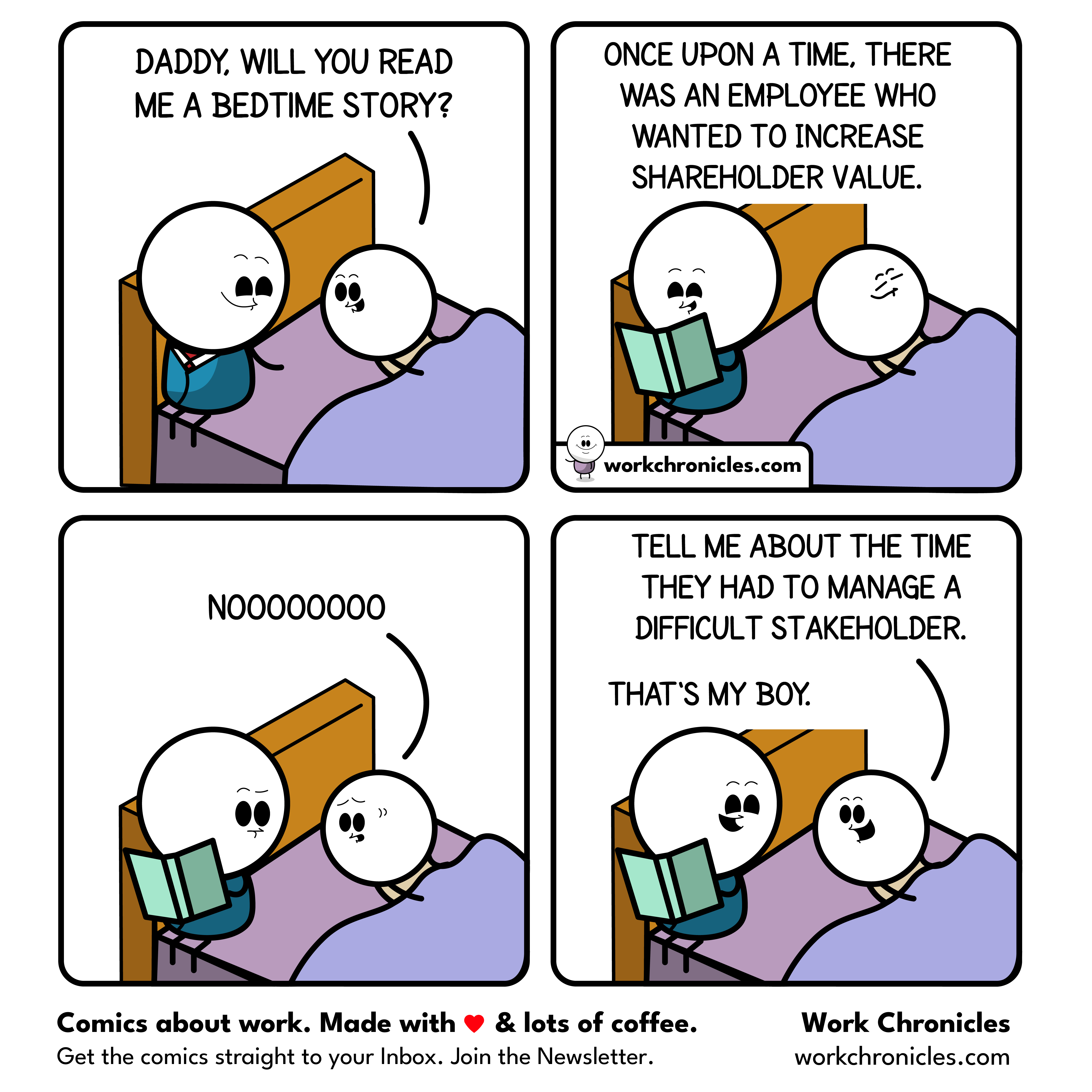
Read the one about the CEO who laid off his entirely family.
(Sleep with your eyes wide open/grip your pillow tight)
Stakeholders are actually very easy to manage. You just have to tell them the truth.
You not only will not have to deal with them ever again, you won't be allowed to.
When my department head reassigned my team lead to another project, I was promoted to be the team lead over my explicit wishes. I wanted to remain technical, and had refused numerous promotions. It was even in my annual evaluations (on record with HR) that I was avoiding the management track.
The director said "tough". He couldn't make me a team lead without me agreeing, but he could make me an acting lead, "temporarily". Of course, with me being the senior on the team, and with him removing the existing lead and having no intention of getting a new one, it was effectively a permanent assignment.
The next day, I went to my first, and only, project meeting. I reported the actual status, not the HappyNews™ that had been reported up until then. And I had the artifacts to prove it.
As the project director (the project manager's boss) told me later, "you were your group's team lead for one day, and I and the CTO were getting phone calls from England", meaning the global head office was demanding answers of our Canadian executive team.
The next day, our director restored the previous team lead from the other project, and she spend four months explaining how we could be a year behind and yet every status report she'd given been absolutely glowing about how we were on track.
Managing a difficult stakeholder is a lot easier than managing a difficult department head. And the best part is, you usually only have to do it once per company.